AI Bid Rigging: Solicitations Designed for You to Lose
Let’s discuss some AI bid rigging red flags.
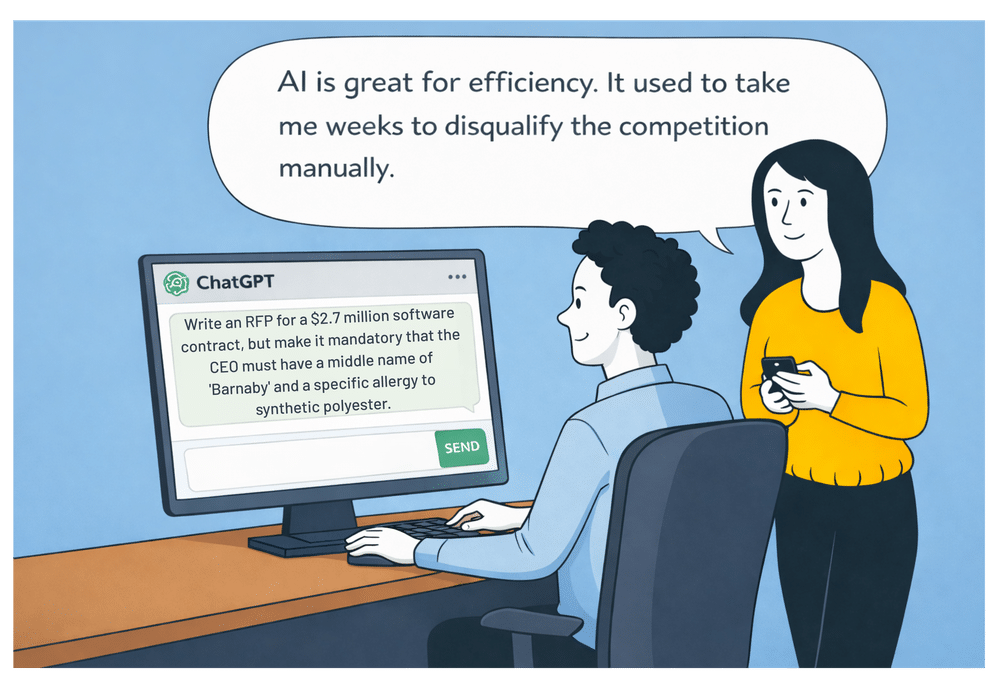
Earlier this year, the procurement industry was rocked by this scandal. In short, a local government procurement employee in Bellingham, Washington, used ChatGPT to draft procurement requirements.
Using AI wasn’t a problem. The prompts he used definitely were.
Turns out, this employee was asking the LLM to bake in hyper-specific requirements to tilt the procurement playing field in favor of his favorite vendor.
He’d effectively tanked the scores of everyone else before the RFP was even released. Predictably, his preferred vendor won the $2.7 million contract.
While rare, there’s no reason to think employee misconduct like what occurred in Bellingham is an isolated incident; in 2026, AI can facilitate corruption as easily as it can summarize this email.
To help you navigate this, we’ve identified three major red flags in modern bids. Any one of these flags alone may not indicate anything is amiss, but when observed in aggregate, you may have a suspicious bid on your hands. Here’s how you can spot favoritism before you waste resources on a sketchy solicitation you were never meant to win.
1. Red Flag: Unusual Processes & Lightning Timelines
AI enables agencies to generate complex bid documents in seconds. If an RFP drops on a Friday afternoon and asks for submissions by the agency’s minimum turnaround time, pay attention. Rushed solicitations can appear performative and may not aim to elicit competitive proposals from serious contenders.
🚩Why it’s a red flag: Standard procurement has a rhythm. When breakneck speed expectations or bizarrely short submission windows disrupt that rhythm, they often favor an incumbent who already holds the inside track.
👉Here’s how to vet it: Look at the agency’s historical patterns regarding solicitation release and close dates. Was this same procurement open for the same amount of time last year? If the submission period has shrunk by 80% but the project complexity is the same… the fix might be in.
Pro tip: Use a bid search engine like Bid Banana to research historical data. Closed bid details often include previous open and close dates.
2. Red Flag: Tailored Requirements
In the Bellingham case, the team used AI bid rigging to draft requirements that were suspiciously specific. If an RFP requires a vendor to have exactly 12 years of experience in a 10-mile radius of the city center or uses terminology unique to one company’s marketing deck, you’re looking at a favorite.
🚩Why it’s a red flag: AI is excellent at synthesizing a competitor’s website and turning their unique selling points into mandatory requirements. This effectively disqualifies everyone else before the bidding even begins.
👉Here’s how to vet it: Run a competitive match audit. Take the most specific requirements and search for them on your top three competitors’ websites. If the RFP reads like a copy-paste of their About Us page, it’s a tailored bid.
3. Red Flag: Unvetted Solicitations
As we discussed in our previous newsletter, AI slop has become the baseline. If an RFP contains obvious AI artifacts, such as overly vague language, evaluation criteria with circular logic, or a scoring matrix that doesn’t add up to 100%, it could mean the procurement officer didn’t bother to read their own document.
🚩Why it’s a red flag: Vague language in a solicitation can camouflage the bid’s subjectivity. It’s possible that a bad actor inserted neutral-sounding fluff that would allow them to justify awarding higher scores to a favored vendor. But even if there is no bias at play, any unvetted solicitation issued with unclear or substantial errors is a red flag. Whether it’s because of a lack of care or because they already have a winner in mind, you can bet their selection process will be just as messy as their solicitation.
👉Here’s how to vet it: Submit a formal Question & Answer (Q&A) request asking for clarifications. If the agency’s response is equally vague or dismissive, they’re either a) overworked (dangerous for you), b) uninvested (also dangerous for you!) or c) seeking a specific bidder. But if you’re still in doubt, it’s never unwise to seek a second opinion from a third-party industry expert (like The Bid Lab— just watch our co-founder Jordan tear into the many red flags of a questionable bid process in Orem, Utah!).
The Last Word
From AI bid rigging to niche requirements to sloppy evaluations, your competitive advantage shifts to bidding with both eyes open— and, if needed, by consulting a third-party expert who knows how to scrutinize bids before you begin your draft. In the meantime, read up on how to use AI in your own bids and RFPs.